Okay so I gotta be honest, because of workloads from other courses I haven't been able to work as much into the patch as I would have liked, specially considering I only have this week left, BUT, let's recap a bit. Last meeting I was recommended to not close my horizons to only configuring the moods as a closed assertion but as a mod value that could add to the general texture, I'm gonna check the viability, while I'm constructing the textures and determining the values, but FIRST, two things to be defined:
1. What are gonna be the moods that I'm gonna develop the textures?
2. How do I make the patch structure to have a consistent harmony that I can build the textured melody on to?
So let's tackle this ones one by one.
1. Mood determination:
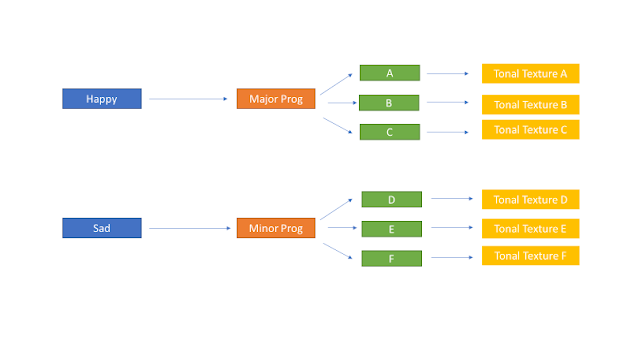
As it was mentioned before the idea is to split the moods between 2 consistent progressions, (a major one and a major one) with the hope of the melody to stay within the confines of the tonic and remain interesting. So to start constructing the textures I had to decide on the moods that I want to work on.
For now I am separating both categories as "Happy" and "Sad" with their moods (for now) being.
Happy:
- Calm (A walk in the forest on an uneventful morning)
- Excited (Battle with the tide in your favor)
- Epic (The party has triumphed in their mission)
Sad:
- Tense (Sounds of predators can be heard around the campsite)
- Worry (The bar is silent when a shadowy figure walks into the room)
- Somber (A party member has fallen in battle)
I will then develop this textures with the general feel of each sequence in mind.
2. Harmony development:
This was a lot more complicated that I had anticipated, without considering a lot of variation, a 4 chord structure would be able to give me a tonal guideline to build my melody on top off, with this in mind, I needed VCV to handle 4 different polytonal chords that would play on a cyclical way.
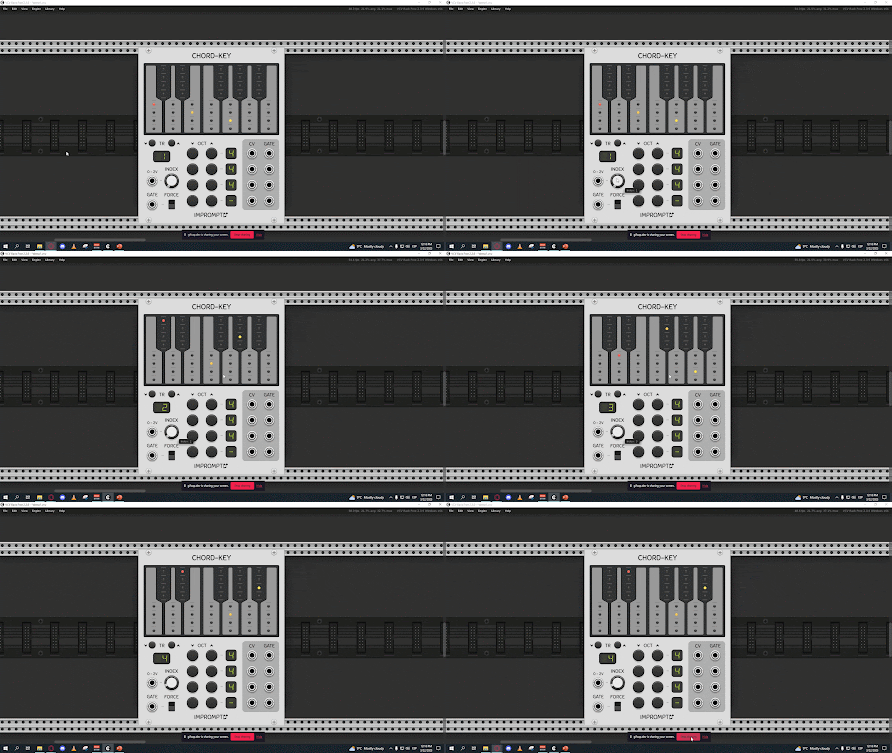
My initial thought was that I could use the index knob in IMPROMPTU's
CHORD-KEY module, in theory, I would be able to change between chords using the same module and only changing the selection of which chord was being played at a time. But turns out, since every value in each module is measured by voltage changes, unless I directly place a trigger on several units that give specific values OR send a direct MIDI signal like the ones I'm sending from the program, every time I need to change chords in the progression, this is not viable.
Another issue that is less obvious when looking at the tool is that although the module successfully generates signals that play the corresponding notes, this notes are independent from one another, each output is section creates a gate trigger and delivers pitch information to different voices, so another problem arose, how do I play the chord as a whole, instead of note by note?
It is worth noting that modules like Autinn's
REBEL do generate a polytonal signal corresponding to a chord based on the input's pitch information and gate, however, like most others, REBEL generates the chord based on a random selection of 14 different chord possibilities, and choosing which ones to select from is not an option.
After a lot of testing the solution came in the form of a
merge module, since the gate is the same for all four notes (at least for now if this later changes a new merge modules would be required to generate a polytonal signal with this information), the module grabs all the pitch information from the CHORD-KEY and when passed through an oscillator, is able to generate a whole chord to be played and controlled.
To solve the second problem (the changing of chords) I was able to find some tools that would allow me to change between the indexes, but they would severely limit the capabilities of each chord and would be really complicated to set up reliably, and considering VCV allows me to have as many modules as I want, the solution came in the form of 4 different CHORD-KEY modules connected to a Gate sequencer, that controls when each of them is being played in a 4/4 compass.
Each CHORD-KEY then, represents a single chord and following the sequencer on the left, each of them is being played on a sequence and have their own respective oscillator being informed through the polytonal pitch information, and mixed in the mixer in the top left, now I can copy this process twice and have a base harmony for both my major and minor progressions.



Comments
Post a Comment